

Research lines
Under construction.
Innovation in tracking technologies
I am specialised in the application of acoustic telemetry to monitor the movement of marine fish. Acoustic telemetry is currently the most widely used technique for tracking aquatic animals, as it enables monitoring large numbers of individuals across broad spatial and temporal scales. By combining this technology with advanced quantitative and modelling approaches, I address a wide range of ecological questions, from fundamental aspects of fish behaviour to applied challenges in marine resource management, including the evaluation of Marine Protected Areas.
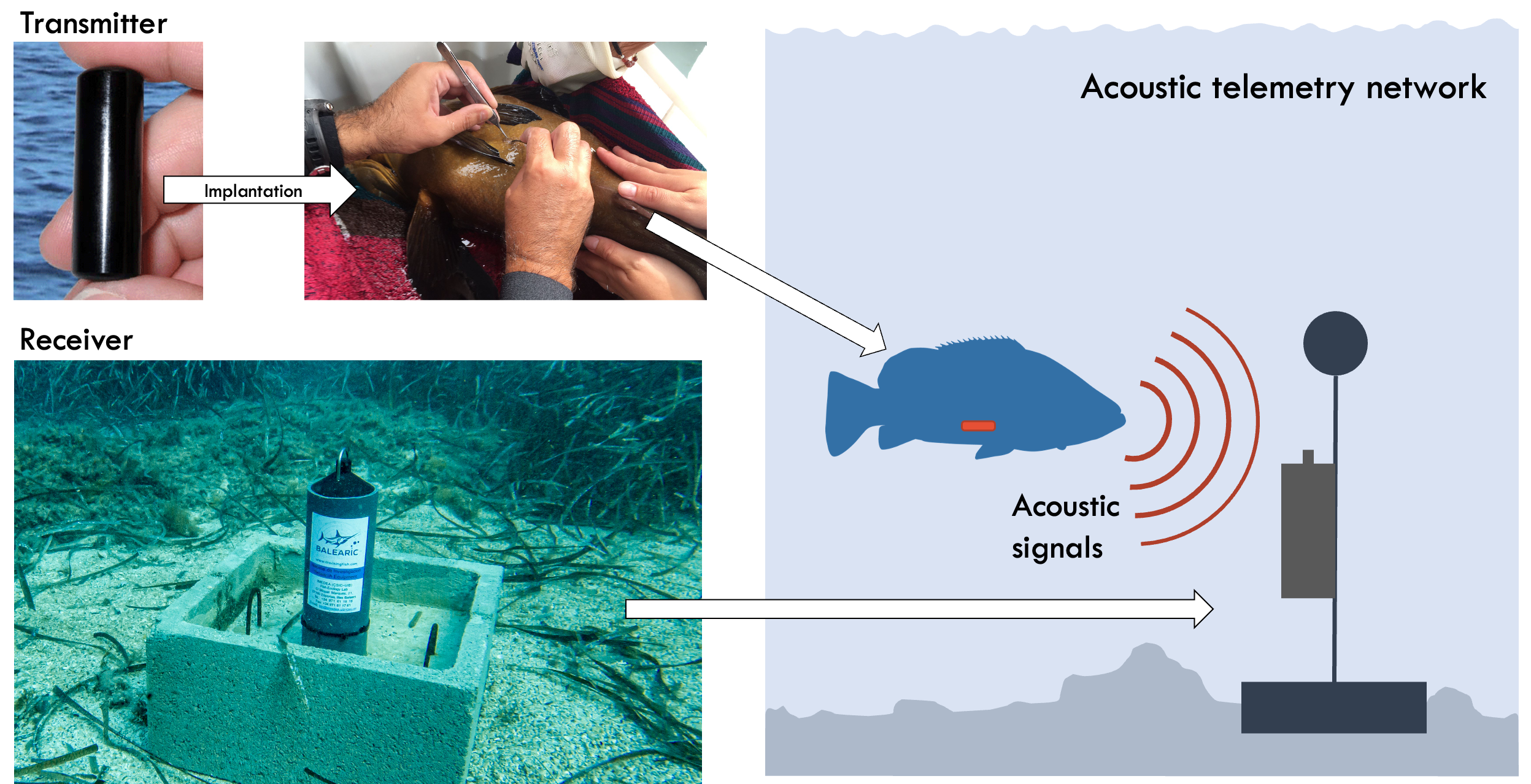
Acoustic telemetry involves equipping animals with miniaturised electronic transmitters that emit uniquely coded acoustic signals, which are detected by receivers strategically deployed on the seabed. By analysing detection patterns across multiple receivers, it is possible to reconstruct movement trajectories, estimate space use and residency, identify habitat preferences, and identify aggregations of individuals. Transmitters can also incorporate environmental and behavioural sensors (e.g. pressure, acceleration, temperature), providing complementary information to contextualise movement and activity patterns.
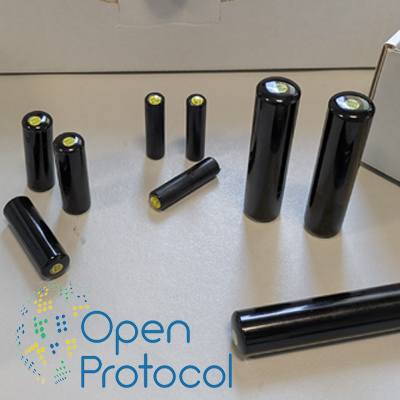
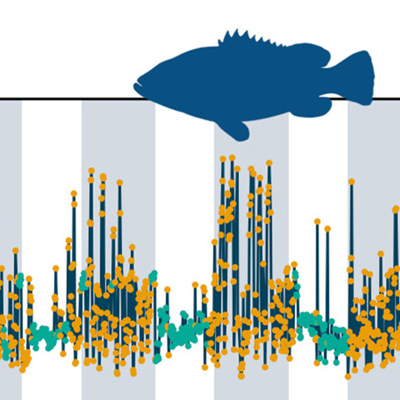
It is an exciting and rapidly evolving field. For instance, through the European Tracking Network, we have contributed to the implementation of Open Protocols for acoustic tracking, which solve long-standing compatibility issues among manufacturers. This innovation enables interoperability among independent receiver arrays, fostering international collaboration and allowing movement studies at unprecedented spatial scales. More recently, we have developed a novel methodological framework to infer activity patterns from simple acoustic telemetry setups.
Selected contributions:
Marine connectivity
Large-scale telemetry systems, in which receivers are deployed across broad geographic areas, allow the characterisation of connectivity patterns of both juvenile and adult fish. Understanding this connectivity is central to marine sustainability, as it determines biomass exchange, dispersal pathways, and gene flow between areas under different protection or management regimes.
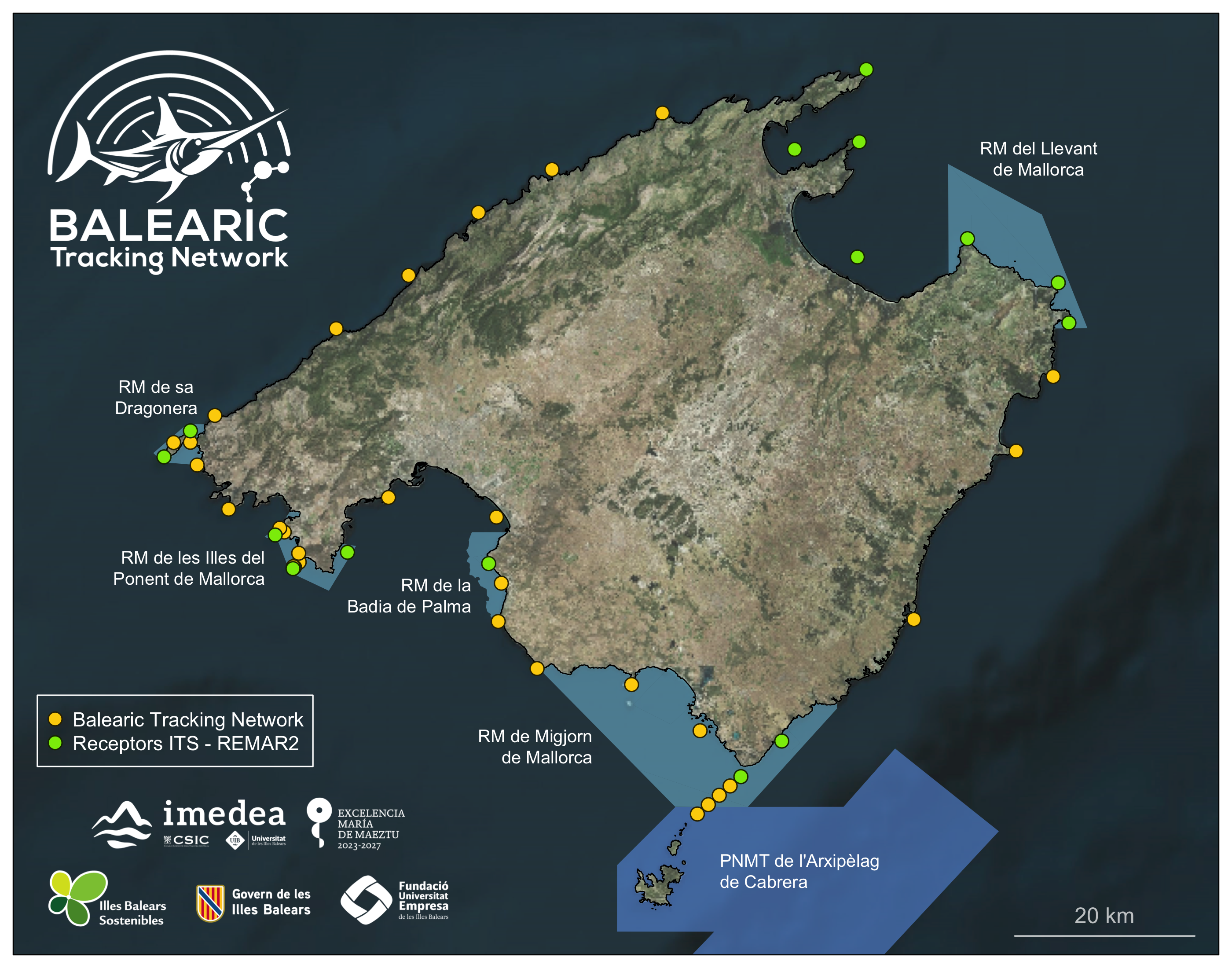
From our research group at IMEDEA (CSIC-UIB), we manage the Balearic Tracking Network, a large-scale acoustic telemetry array covering the Balearic Islands. Due to their geographic position in the western Mediterranean and the high density of designated Marine Protected Areas, the archipelago provides a strategic setting to investigate the role of MPA networks in fish conservation, as well as the ecological linkages between islands and the mainland. This infrastructure generates empirical data on large-scale movement and spatial connectivity, supporting marine spatial planning and fisheries management decisions.